Tag: foreigner

Recent Posts

What if


My seasonal foreignness was not so bad this year.
Maybe because I was too busy vacationing to deal with existential issues. Maybe because when you are expecting something, it is almost never as bad as you expect it to be. It wasn’t. The irony is that when things go well on the foreignness front, another set of existential issues comes to the surface – the “what ifs.”
I felt cosy and comfortable being around family, seeing familiar faces that I had not seen in a while and meeting some new ones. It was – momentarily and in the un-real-life context of a vacation – as if I had never left. One thing led to another and at some point, I could not help thinking, wondering how it would feel if I actually lived there. What would happen if I returned? What would real life there look like? Would my children be happy? Would I still feel like a foreigner at home and if I did, would that be such a
big deal?
I indulged myself, building scenarios in my head,
imagining scenes from our daily life in Athens. I visualised the late summer days, still warm and sunny, with the evenings a little bit cooler and the sun setting earlier, announcing the onset of autumn. The city filling up again. The first autumn rain after several months of dryness (there is actually a word for that in Greek). What would it be like to spend winter there again and not just a couple of sun-drenched weeks on the beach? Would I create my own daily routines? Would the constant presence of my extended family be bliss or torture? Would I get used – again – to calling 15 degrees Celsius (the temperature this August morning in my current home town) “winter temperatures?” Would I be able to reconnect with all those – inevitably – long lost friends? Would I make new ones?
For a moment there, I did not think of all the reasons why this is an impossible scenario. I did not rationalise and it felt good. I felt free. But eventually, I did feel sad. Because the “what if…?” is always followed by the “why not.” Without a question mark at the end.

Seasonal foreignness


Every year , around the start of summer vacation, I hear the same familiar complaint from my children: “Why do we always have to go to Greece for vacation? Why can’t we go somewhere else for a change?” Every year, my answer is the same (including the part where I tell them how spoiled they are and that other kids – not to mention adults – would be thrilled to go to Greece for
vacation, while they are being so difficult about it): “Because your mother is from Greece, which makes you half-Greek, and this is our home.” But is it really?
Lately, I have been reading a lot about what happens to people when they move back to their home country after having lived abroad; how the experience is predictably rewarding but can also be unpredictably challenging. The fact that the challenges catch most people completely by surprise is the main reason why repatriation is so hard to cope with. Not having been through it myself, I have been trying to find ways to relate to that experience, so that I can write about it.
In fact, a lot of what I have been reading about re-entry reminds me of what happens when I return home for longer periods of time, which is the case every summer. Many expatriates who go back to their passport countries find that home does not feel like home any more; that they have become foreigners where they least expected that to happen; that their loyalty is divided between two (or more) “homes.” That’s something to which I can relate. It does not make such a big impression on me now – maybe because I have been used to it over the years – but being home always reveals that split in my life and in my identity. On the one hand, I have a strong bond with Greece. It overwhelms me with euphoria the moment the airplane touches down on Greek soil and crushes me with nostalgia when that other airplane takes me away. I love everything about “my” country – its natural beauty and its (disorganised) chaos; the warmth of the weather and that of the people; the fact that I can understand both the text and the subtext when I interact with them; the feeling of belonging.
On the other hand, when I am in Greece, I am always the visitor; the tourist; the foreigner. Nothing much is expected of me. I am not supposed to completely fit in, but that feels strange rather than liberating. There are moments when I miss the comfort of being a foreigner somewhere where I am actually justified in being one, rather than somewhere where I really shouldn’t. And, of course, after a while
I start missing my “other” home; my house; my routines. To quote Kundera, (my) life is elsewhere.
Many of us perpetual foreigners experience this duality – the “split personality,” the unexpected emotional connections to different places at the same time. The contrast is always there, but it is only when we come “home” that it becomes blindingly obvious.
Do you feel foreign, at home?

Closing doors


When one door closes, another opens…right? I hadn’t known that the famous quote from Alexander Graham Bell goes on to add: “…but we often look so long and so regretfully upon the closed door that we do not see the one which has opened for us.”
Being able to close some doors and open others, to look ahead and not back should be key skills to have when one leads the nomadic life. Isn’t that a large part of what we do when we move constantly from one place to the next – dismantle our existence and
rebuild it, in a slightly different way, somewhere else; close one door and open another?
Does this mean that all of us who choose the mobile life have what it takes – namely the ability to let go and move on in absolute smoothness? Is there hope for those of us who are not naturals and find it extremely difficult to close doors – despite being excited about the ones that open? Even though we do get better at it with every move, it is always hard. And painful. Sometimes heart-breaking.
It helps not to see it in absolute terms. Yes, we should be getting better at closing doors, but we don’t need to close them all the way. We should be developing our proficiency to
bravely and skilfully move on to a new life, but there are elements of our previous life that have become part of our identity and make us who we are. We don’t close the door to those the same way that we don’t close the door to the people from our various past lives. That makes it easier – at least when you are an adult and can reason that way.
It’s different for kids. They see things in much more absolute terms. They don’t think in terms of the big picture.
When we left Vienna last summer, we were not sure how long we would be away, so we asked the schools to “reserve” spots for our children for
another year, in case we came back. That year has passed and yesterday we had to officially give up those places. As happy as I am with our new life here and all the new doors that it has opened, it still felt strange to close the last “old” door that was still open.
I’m not sure how the children will react when we tell them. They could see this as a sign of stability in their new life; less uncertainty. But it could also be that, in the back of their mind, those reserved spots were a silent promise that they could always go back; a secret outlet for when they were not too happy with their life here. Do we take away that outlet? Or do we wait until the excitement about the new doors becomes more powerful than the regret about the ones that are now closed? Even if, in the grand scheme of things, they are not really closed.

Counting blessings

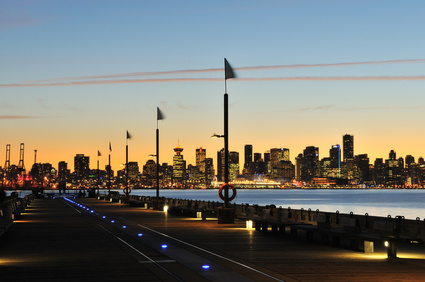
Although today’s post is not technically about crossing cultures or the expat life, essentially it is. To start, I am writing it from a place halfway around the world from where I call home; a place that has become home for a loved one, a member of my family. Though this was the main reason for visiting Vancouver, the city is also home to some other very special people in our life, so how could I be surprised when I felt an immediate connection to this city – its landscape, its vibe and most of all, its people. Besides all the personal reasons, I should have guessed this would happen from the pure fact that Vancouver is built on the shores of an ocean. I was bound to feel at home here. What I did not guess was that the main reason I would feel so welcome from day one would be the people. I have been to a few places – my current home included – where people are pleasant, polite and welcoming, but not yet to a place where all that is overlaid by an air of unambiguous authenticity and warmth. This is not your typical North American friendliness – there is a sincerity and kindness to it that makes it unique.

On our second day here, even though we had not slept well the night before and were still being brutally assaulted by jet lag, we decided to walk to the waterfront. Unfortunately, we overestimated our energy levels and after a couple of hours, the kids were tired and needy. No wonder. Their bodies must have felt confused. Schedules, mealtimes and nap times were all still a jumble. I was running out of patience, being exhausted myself. Just as we had finally managed to find a taxi to get back to our hotel (since nobody was up for walking), my youngest insisted on getting in the car by himself and, in his attempt, fell into a puddle of dirty rainwater.

That was probably the last straw for me, because I lost it. As I started fussing about how I’d had enough of all this and all I wanted was to go back home to Switzerland, an elderly lady who was passing by, overheard me and stopped. She took my hand and told me to calm down. She looked in my eyes and said: “As long as the sun is shining [which it was], you cannot be upset.” She pointed to my children and said that I should be thankful for such a beautiful and healthy family. “Besides,” she concluded, “how can you be unhappy when you are in Canada – the best country in the world?”

She said all that in such a gentle, non-judgmental manner that I felt embarrassed for having made a fuss. Her English had a barely detectable accent, which made me think that she might not have grown up in Vancouver, but had felt happy and comfortable enough there to make it her home – the best place in the world. Her kindness and wisdom left their mark on me. I really do feel thankful for everything I’ve got.
Leading a nomadic life is not always easy. It is rewarding, but it is also challenging. Not everything runs smoothly all the time. There is loneliness, exhaustion, frustration, even anger sometimes. When I feel that way, it helps me to remember the words of the wise lady who stopped me on the street that day in Vancouver. Stop and smell the flowers. Take a deep breath. Count your blessings. We tend to forget to do that, but it really works.

Leaving the Zone


I have a confession to make. I have been indulging myself. I have been allowing myself to hide from the world.
Since we moved here at the end of last summer, I have been busy unpacking and setting up house, figuring how to get to places and how to get things done, and making sure everyone in the family is settled and happy. That hardly leaves any time for a social life, doesn’t it? So I felt that it is normal that I have not been able to go out and meet people, join clubs or be part of the PTA. Instead of feeling frustrated by this, I have been enjoying the solitude, my family, my writing. I have been relishing the quiet evenings and weekends. I have been convincing myself that this time alone is exactly what I need to recharge my batteries and get settled after the move. I don’t need to meet new people right away. I don’t need to reach out.
I may have gone a bit too far. I have used my newcomer identity as an excuse for being asocial.
Everyone I have talked to about relocating, every book and every article I have read gives the same advice: if you want to make a speedy and smooth adjustment, one of the first things you need to do is get out. You need to meet people and you need to do it
early on.
I resolved that this rule does not apply to me and moved on.
The truth is that I have been too reluctant and too scared to venture out of my comfortable new shell. Scoring substantially high on the introversion scale, let’s just say that I am not a
networking natural. Going out with the explicit goal of meeting new people is intimidating, to say the least. So I allowed myself to be lazy. I was content with the few people I happened to know here from the beginning and did not feel that I needed to expand the circle – at least not any time soon. I was happy to stay in my comfort zone. I had the perfect excuse: I was a newcomer, a foreigner.
Except that this excuse is only valid for a limited time. How long is one considered a newcomer? Wouldn’t seven months be pushing it a little? When someone asked me the other day, I was shocked to hear myself reply that we have been here for more than half a year. I still have the same six friends that I had back in September. I still don’t have an emergency contact on my children’s school forms.
Some of us are disciplined enough to do the right thing at the right time. Some of us – that would include me – need action-forcing events. Recently, I got one of those. Clearly, it’s time to leave that delightfully cosy comfort zone of mine. I’m a bit nervous, but I
hear that, if you put in the hours, you eventually become pretty good at it.
Do you find it easy or challenging to create a social circle when you move to a new place?